Research
Academic Approach
I am a critical marine ecologist with a penchant for understanding how young life stages of fishes and invertebrates, particularly those found in in nursery and/or freezing habitats, may cope with rapid anthropogenic change. My graduate and postdoctoral research training was primarily rooted in classic environmental physiology, of which research – including infamous research on Antarctic fish physiology (e.g., ‘antifreeze glycoproteins’) – has focused on describing how animals mechanistically cope with environmental ‘stressors’ on cellular and organismal levels. The approaches I integrate from this training span comparative animal physiology, animal behavior, community and habitat ecology. My academic perspective is also still deeply informed by my foundational education in the marine sciences.
More holistically, though, my academic perspective and research approach has also been greatly influenced by a diversity of scholars, disciplines, and knowledge systems throughout my training, not just in the natural sciences, but also Indigenous and Traditional Ecological Knowledge, feminist and critical theory, disability and queer studies, and art and literature. The more I have stepped out of the silo of the natural sciences, the more expansive my learnings and perspective have become, which has in turn deeply shaped my ecological research. An important practice in my research is considering what systems of power are at play and how they may be influencing the science and knowledge that I am engaged with. I also embody my values in my research, like hope and care, and rather than striving to meet the impossible goal of the objective observer, I choose to honor my unique perspective, and I have directly witnessed how much stronger this approach has made my work. From my connection to my study sites and species, my field observations, the questions I ask and how I approach them, my interpretations and applications of results – everything I do as a researcher is informed by who I am as a person and the diverse knowledge and experiences that I bring to my work. These approaches and perspectives are why I describe myself as a critical ecologist and an activist academic.
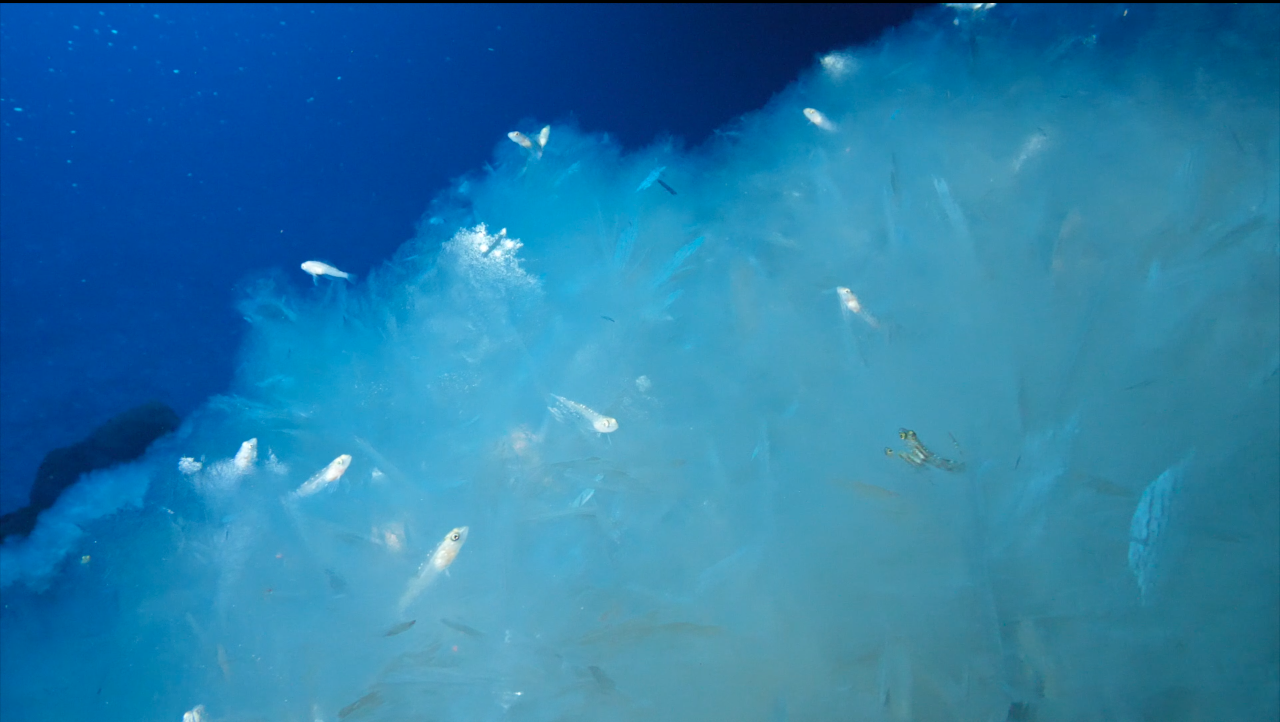
Juvenile Trematomus spp. fishes in ice reef habitat in McMurdo Sound, Antarctica. Photo by: Rob Robbins
Ice reefs
Ice-association in fishes is often viewed as a unique occurrence, but in this manuscript, I review that ice-association may be a much more widespread life history strategy in polar fishes than appreciated.
I also propose the ice reef framework, which I developed during my dissertation research and fieldwork at McMurdo Station in 2018 and 2019. I posit that ice reefs provide abundant nursery habitat for polar fishes and that they are in urgent need of study.
Publications
(In prep)
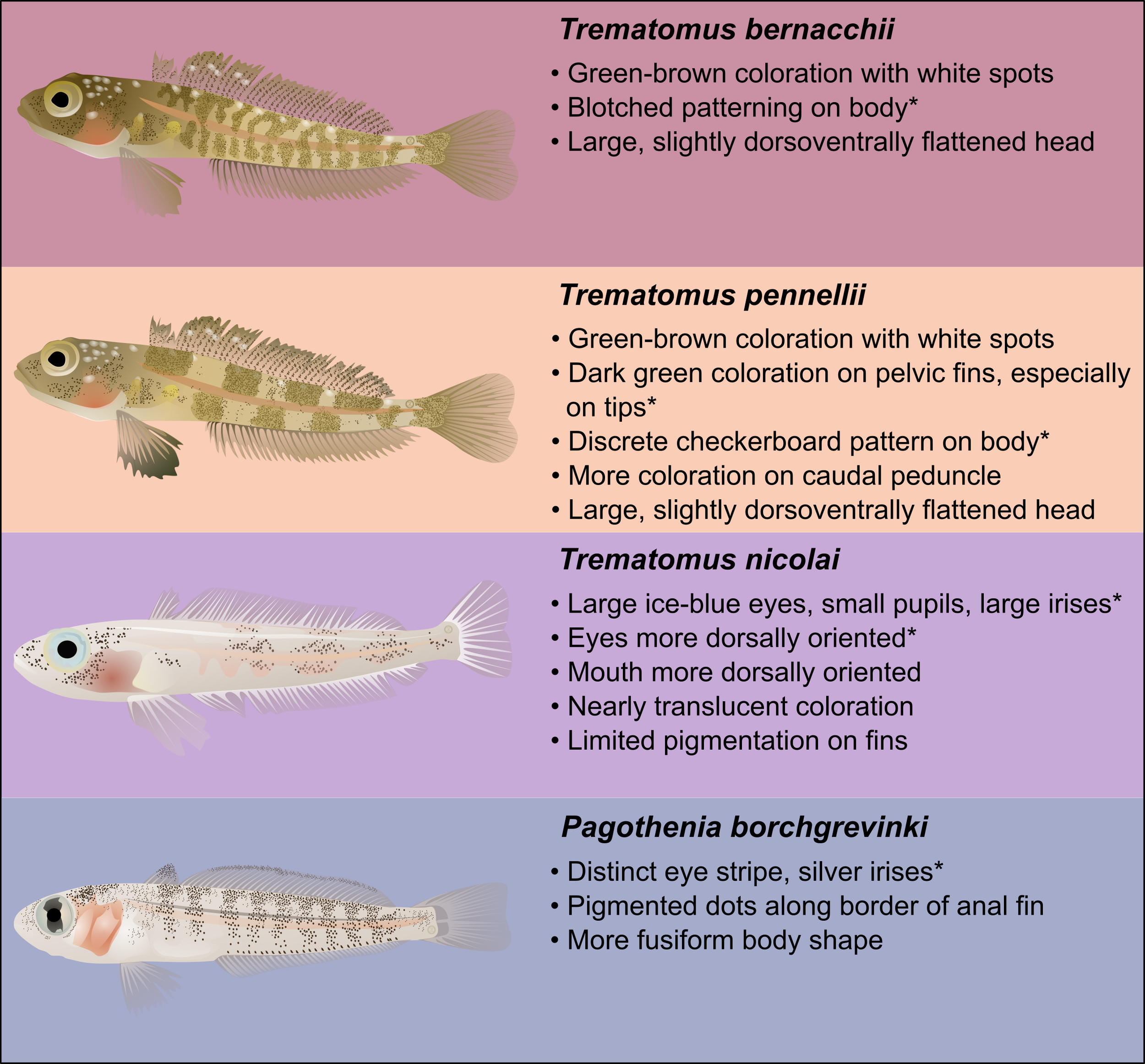
Identification guide for juvenile life stages of four abundant species in McMurdo Sound, Antarctica: T. bernacchii, T. pennellii, T. nicolai and P. borchgrevinki (Frazier et al., 2026). Digital illustrations are done by Dr. Jess McLaughlin. We include remarks of distinguishing features; the most defining features are starred.
Niche differentiation in Antarctic fishes
As climate change continues to accelerate, it is expected that some species will be ‘winners’ and others will be ‘losers’, and this differential performance across species is expected to reshape foodwebs and ecosystems. We can look to fundamental axes of niche differentiation, like exploratory behavior and metabolic physiology, to inform species-specific predictions.
Publications
Frazier AJ, Naslund AW, Mandic M, Zillig KW, Siu BC, Todgham AE (2026) Divergent exploratory-avoidant behavioural strategies may drive niche differentiation in juvenile Antarctic fishes. J Fish Biol, 1–20. doi: 10.1111/jfb.70473
Naslund AW, Zillig KW, Mandic M, Frazier AJ, Todgham AE (2026) Differential temperature preferences exhibited in the juvenile Antarctic notothenioids Trematomus bernacchii and Trematomus pennellii. Sci Rep. doi: 10.1038/s41598-026-64720-4
Mandic M, Frazier AJ, Naslund AW, Todgham AE (2022) A comparative and ontogenetic examination of mitochondrial function in Antarctic notothenioid species. J Comp Physiol B 192, 737–750. doi: 10.1007/s00360-022-01461-6
The human footprint in Antarctica
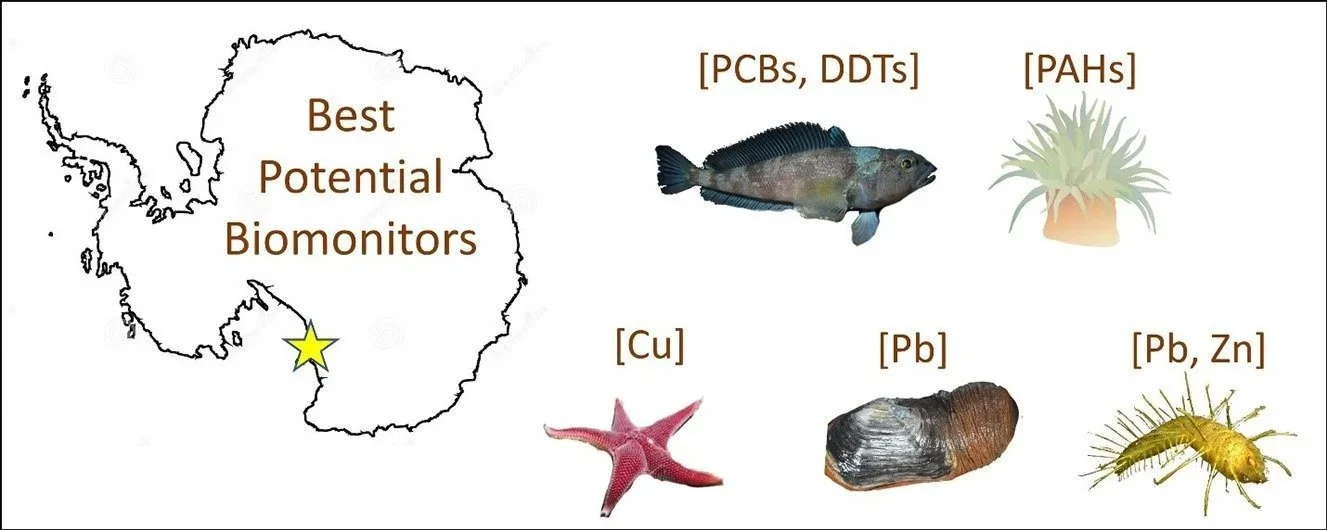
Graphical abstract for Palmer et al., 2022, showing the best indicator species for each contaminant.
My first experience conducting Antarctic research was during my undergraduate, as part of the Observing the Oceans NSF REU at Texas A&M in 2015. I analyzed biogeochemistry data collected at McMurdo and Palmer stations to understand the human footprint — i.e., chemical contamination — at McMurdo and Palmer Stations, Antarctica. In this work we found that different species accumulated high levels of different contaminants, indicating that a species-specific approach may be best suited for bioindicator selection and ecological monitoring.
Publications
Palmer TA, Klein AG, Sweet ST, Frazier AJ, Montagna PA, Wade TL, Beseres Pollack J (2022) Using epibenthic fauna as biomonitors of local marine contamination adjacent to McMurdo Station, Antarctica. Mar Pollut Bull 178:113621. doi: 10.1016/j.marpolbul.2022.113621.
Seagrass meadow community ecology
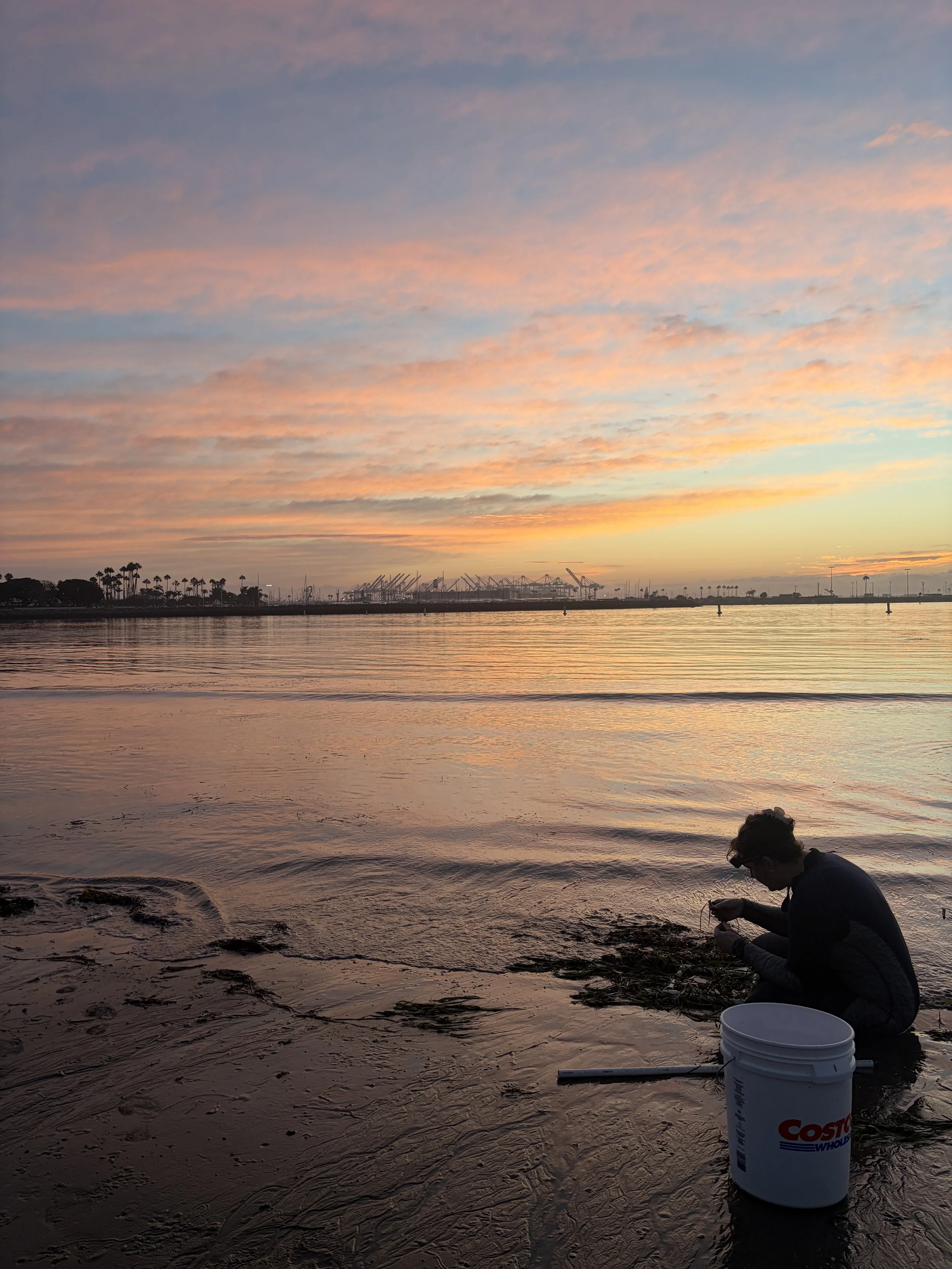
I am leading a long-term ecosystem monitoring study, in which we survey monthly, to understand the important drivers of eelgrass health and phenology – at the southern edge of its range and in what is projected to be the strongest El Niño ever recorded, invertebrate community and fish assemblage biodiversity, soil biogeochemistry, and environmental conditions (i.e., sea surface temperature). Stay tuned as this research progresses!
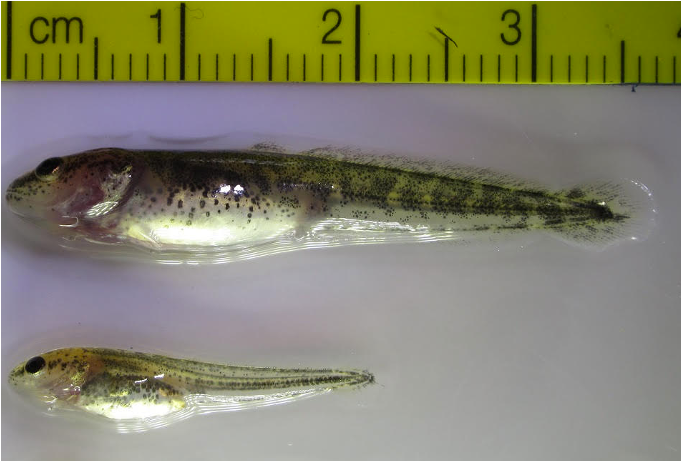
Example of body size differences in cannibal (top) vs non-cannibal (bottom) feeding strategies of individuals from the same cohort. Photo by Neil Ashton.
A cannibal feeding strategy
The practice of mitigating cannibalism in aquaculture is an important focus for hatcheries seeking to maximize yield and has been maintained in hatcheries focusing on wild stock restoration. Cannibal burbot, however, are drastically larger than their non-cannibal siblings, suggesting a potential performance advantage of a cannibal feeding strategy. For my master's research at UC Davis, I examined the metabolic performance differences between cannibal and non-cannibal burbot, Lota lota maculosa, at the Kootenai Tribe of Idaho Twin Rivers Hatchery in Moyie Springs, Idaho, USA. By examining metabolism on the cellular and whole-animal levels of biological organization (i.e. cellular metabolic enzyme activities and whole-animal respirometry), I found that cannibal and non-cannibal burbot exhibit distinct metabolic strategies, supporting the idea that each feeding strategy may indeed demonstrate larger physiological performance differences. This project provides an example of the importance of re-thinking standard practices to achieve conservation goals.
Publications
Frazier AJ, Jensen NR, Young SP, Todgham AE (2020) Does a cannibal feeding strategy impart differential metabolic performance in young burbot (Lota lota maculosa)?. Conserv Physiol 8(1): coaa034; doi:10.1093/conphys/coaa034.